
VAT No. 03448000921
© Copyright 2021 Consorzio Natura Viva - All Rights Reserved


Grotta San Giovanni
Domusnovas - South Sardinia
The longest drive-in cave in the world

San Giovanni Cave, simply UNIQUE!


A UNIQUE experience, suitable for everyone, young and old, and also for our four-legged friends!We are open every day: book your visit now!

Hours
Hours
Prices
Guided tours:
Info-Point
Self-guided visit:
Every weekend :
- at 11:00, at 14:00 and at 16:00
Monday to Friday:
- from 10:00 to 17:00
Weekends and holidays:
- from 09:00 to 18:00
- €8.00 Full ticket
- €5.00 Reduced ticket*
Interactive visit:
Autonomous and interactive visits:
- €10.00 Full ticket
- €6.00 Reduced ticket*
Monday to Friday:
- from 10:30 am to 4:00 pm
Weekends and holidays:
- from 9:30 am to 5:00 pm
Contacts
Guided Tour:
- €12.00 Full Ticket
- €7.50 Reduced Ticket*
Daily Ticket
- €2.00 more than the cost of the selected visit each.
Bike and Runner Passage:
From Monday to Friday:
- from 10:00 to 10:30
Weekends and holidays:
- from 09:00 to 09:30
Bike and Runner Crossing:
- €2.00**
- €3.00 Daily ticket
E
st
ension dedicated to those who purchase the
bike-runner transfer service!
*Children from 6 to 12 years old, and over 65s are entitled to a reduced ticket. With our family package, the reduction is extended up to 18 years old!
**The bike ride and the extension of the daily ticket are guaranteed only during the open gate and according to the times specified above.
The cave as you've never seen it before


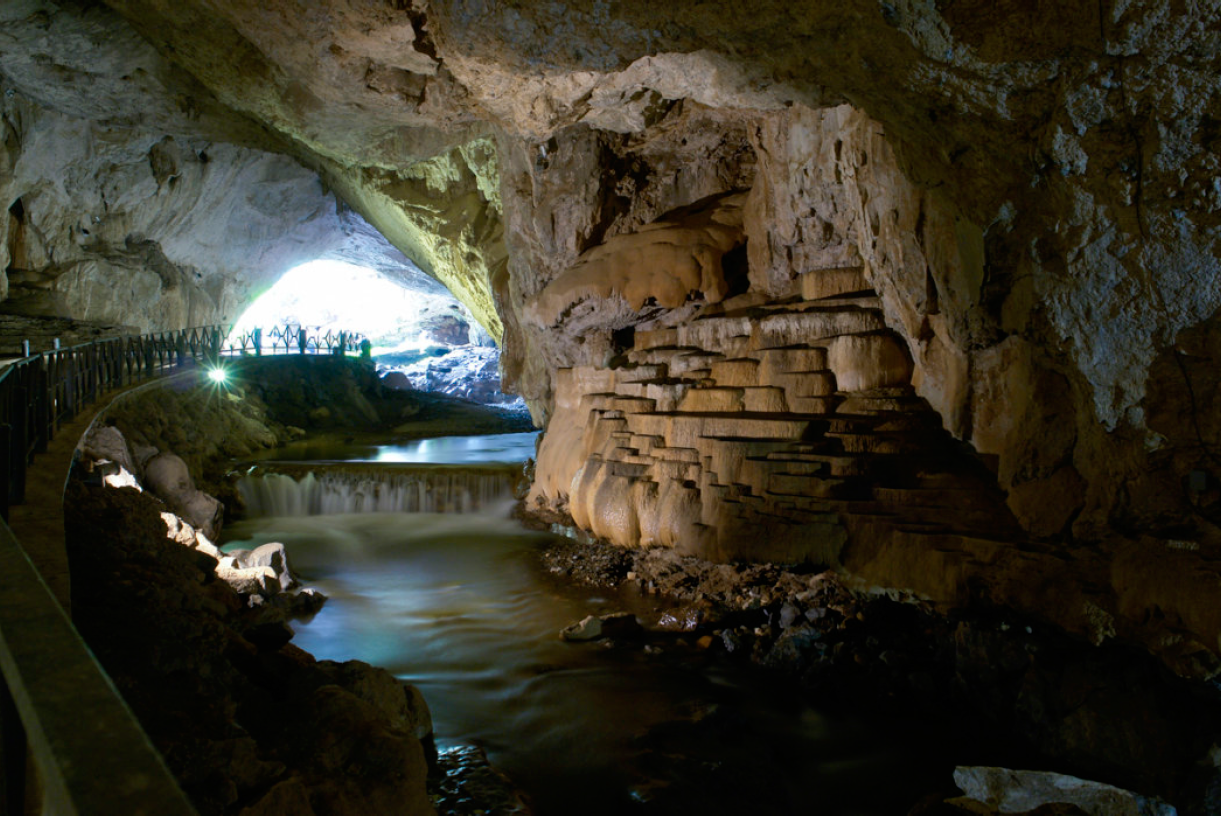
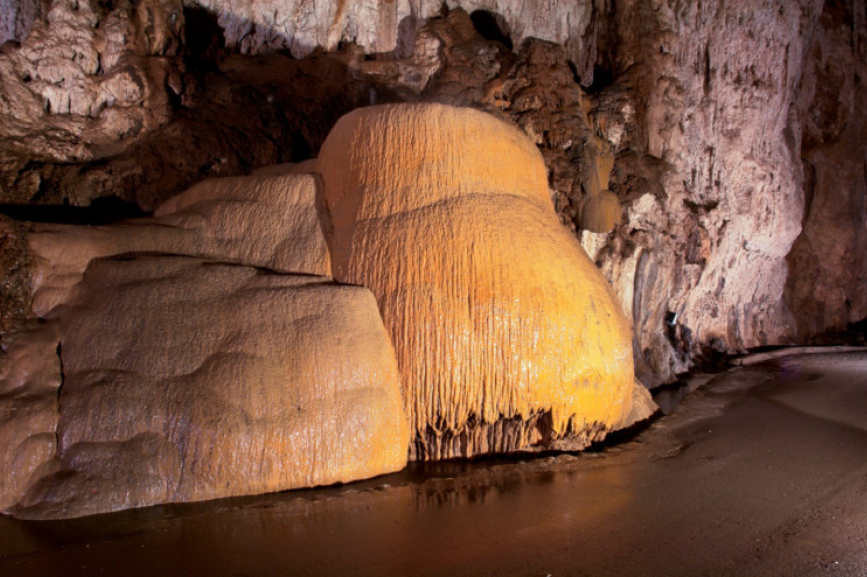
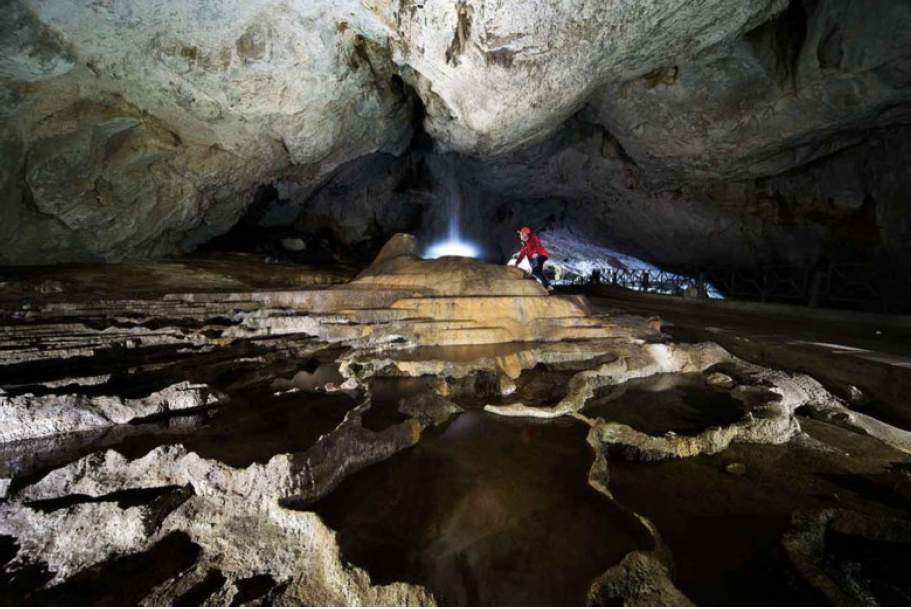
Sa Trona
Le Gours
The South-West Branch
A large "canopy" adorned with stalactites and drapes
under which a large and stocky stalagmite with a completely flat top has developed. This is called "sa trona," and it resembles a pulpit. The upper canopy was formed by the laminar flow of concreting water coming from a large fissure
(presumably interstratal) in the ceiling.
One of the most spectacular concretion complexes in the entire cave, with the peculiarity of being divided into two parts by a blade of rock.
Also called the "bat branch," it begins with a narrow passage that immediately leads to a chamber with a floor dotted with stalagmites, and a ceiling usually occupied by some families of bats.

The History
The San Giovanni cave, with its 860 meters of internal road, is classified as the longest driveable cave in the world, the only case in Italy and one of 7 cases in the world.
It is a fascinating cave where you can admire the karst phenomenon.
From a geological point of view, the entire area dates back to 530 million years ago, formed by carbonate rocks.
Today it is a destination for a great number of tourists, attracting about 100,000 tourists a year,
for some years now it has hosted an international choir festival,
and above all it is a destination for speleologists and climbers from all over Europe who come to climb its walls and secondary branches.
In addition to the easy internal road, which remained freely open to car traffic until 1999 and represents the main branch,
there are also secondary branches whose access is reserved for expert speleologists, including:
• Su stampu de pireddu
• Bobore Branch
Adding the main branch to the secondary ones, the cave reaches a total length of 3,920 meters.
Before the construction of the internal road, it is believed that it was used as a shelter and dwelling, as artifacts and pottery dating back to the Neolithic and Byzantine periods have been found.
At the respective entrances there were prehistoric cyclopean walls (the remains of which are still visible today, especially at the South entrance), and a chapel of Byzantine origin unfortunately demolished at the end of the 19th century to allow the construction of the road. Nevertheless, a commemorative church dedicated to San Giovanni was built on the road to the left of the cave, flanking the South entrance.
There are numerous historical documents that speak of the cyclopean walls thanks to the many travelers of the 1800s. Among the most important we remember King Carlo Alberto, Valery, Francesco d’Austria d’Este, General Alberto la Marmora, Father Angius and many others.
The construction of the road, whose material was partially obtained from the walls and the chapel, was started in 1866 by Count Pietro Beltrami and later completed by Knight Gaetano Semenza to create a communication route between the town of Domusnovas and the Oridda valley, as it hosted numerous mining activities and they wanted to facilitate the transport of minerals downstream.

What they say about us


"Thank you for giving back the splendor to our caves"
"I have walked inside the caves for about 15 years of my life, I have never seen them so beautiful and clean"
"They have always been wonderful, now even more so!"
Fily Manca
Claudio Matzuzzi
Deborah Vargiu
